Anastasia Nikolaeva

Custom financial models for the decisions that shape your business

I build custom financial models to help you understand an existing business, evaluate a new project, launch a startup or prove client ROI in a complex sale.

From founding to value

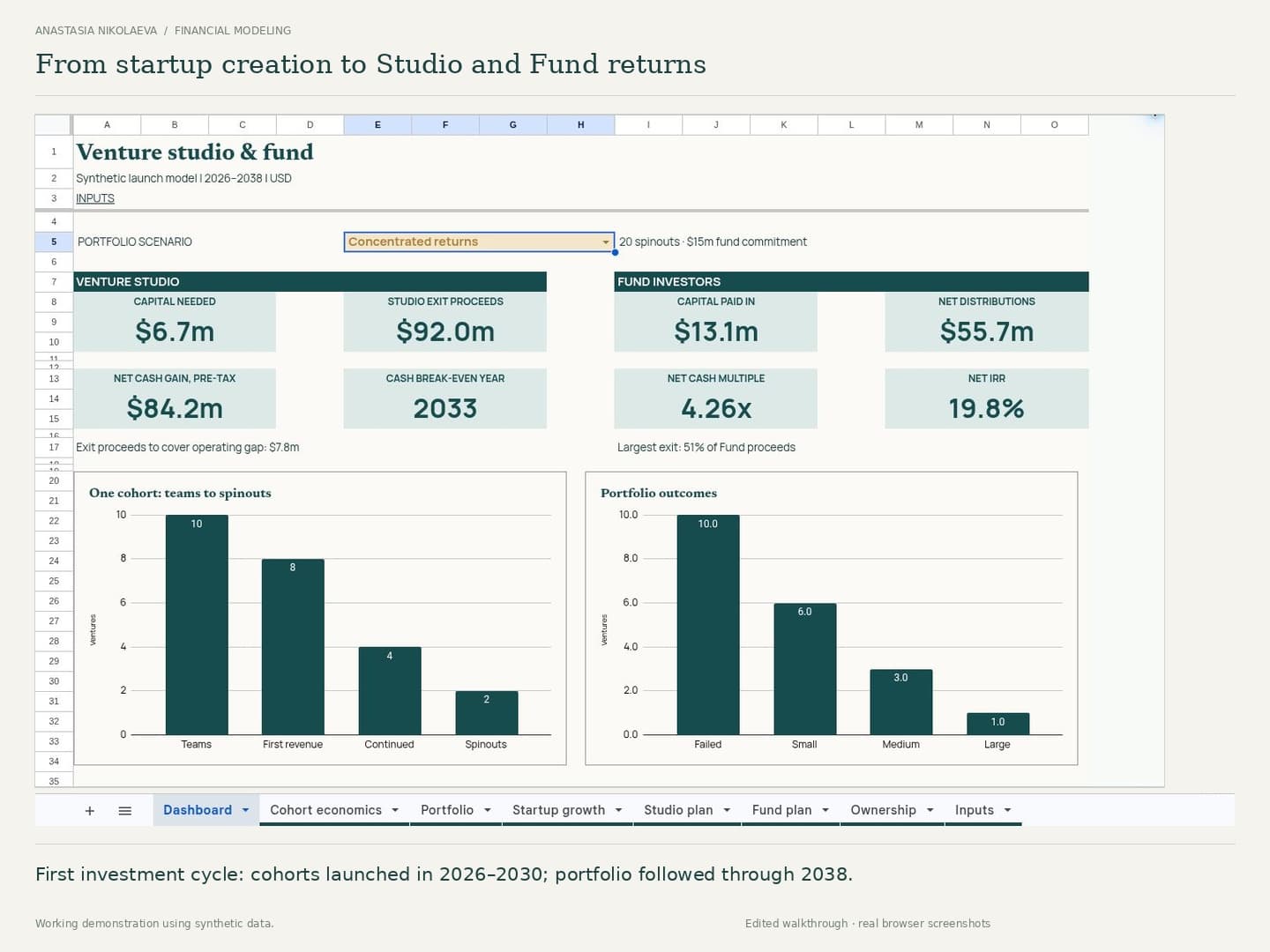
  1. Launch
  2. Year 1
  3. Year 2
  4. Year 3
  5. Year 4
  6. Year 5
Monthly revenue
$0
Monthly EBITDA
−$25k
Valuation
$0

5× annual revenue

Illustrative path — not a client result

A financial model should reflect how the business actually works

For 15 years, I have been responsible for commercial and financial results—first in leadership roles and now as an independent consultant in finance and business strategy.

That experience shapes how I build a model. I start with how the company operates: where revenue comes from, what drives costs, how cash moves, and how different decisions affect the result.

Alongside my consulting work, I teach applied business planning and finance as a guest lecturer in university programs and develop Stavia Models, a financial planning tool for startups.

Anastasia Nikolaeva

What decision does the model need to support?

The work usually starts in one of two places: an operating business with real results, or a new venture or project built on assumptions.

01

Operating business

The business is already producing results. The model should show what is driving them, where performance is being lost and how the next decision will affect the financial outcome.

Performance

See which products, customers, prices and channels create margin—and which absorb cash.

Planning

Reconcile actual results with the plan and rebuild the forecast around what has changed.

Decisions

Test pricing, sales, hiring and investment choices before they affect profit and cash flow.
02

New venture or project

The opportunity is still built on assumptions. The model should establish whether the economics justify the time, capital and risk required to pursue it.

Economics

Translate the commercial assumptions into revenue, unit economics and cash flow.

Capital

Calculate how much funding is required, when it is needed and how long it must last.

Return

Compare scenarios, break-even timing and the conditions required for an attractive return.

How we work together

First, we agree the business logic. Then we use data and documented assumptions to build a forecast you can work with.

Before the build30 min

Start with a free 30-minute consultation

We discuss your goals and decide whether we are a good fit. After an NDA, I review your materials, and we agree the model’s structure, outputs, fee and timing.

Does this reflect how your business works?

A detailed working session shapes the calculations around your revenue, customers, costs and operations. I build the logic using illustrative inputs so we can test how it works.

We review the logic together

You check the business relationships; I test the calculations. We refine the structure before developing the forecast.

We revisit the logic whenever new evidence calls for it.

Build the logic

Does this reflect how your business works?

A detailed working session shapes the calculations around your revenue, customers, costs and operations. I build the logic using illustrative inputs so we can test how it works.

We review the logic together

You check the business relationships; I test the calculations. We refine the structure before developing the forecast.

We revisit the logic whenever new evidence calls for it.

Test the forecast

What happens under realistic assumptions?

We bring in your actual data and agreed assumptions, identify gaps and challenge the forecast. I develop base, upside and downside scenarios around the decisions you need to make.

Every assumption has a basis

I document whether each input comes from your actual results, a market benchmark with a cited source, or an estimate we agree together. Any assumed change from current performance is made explicit.

We review the results together

We check whether the outputs are credible and useful for planning, investment or day-to-day decisions.

Cash-flow scenarios

UpsideBaseDownside

Cash balance

TodayTime

Illustrative scenarios, without client data.

After acceptanceHandover

A model you can keep working with

After you approve the agreed work, I transfer the files to your workspace. A straightforward new-venture forecast can take around two weeks, depending on scope, available inputs and timely feedback. Larger projects can be completed in separately agreed stages.

Your data and workspace

We can work in your workspace from the start or transfer the model at handover. If you prefer to keep your figures private, I can build and test the logic with illustrative inputs for you to populate internally. Validation of your actual figures then stays with your team.

Project fee and payments

We agree the scope, outputs, included revisions and total fee before starting, then sign the agreement. The usual arrangement is 50% in advance and 50% after acceptance. Additional scope is agreed separately; larger engagements can be scoped and priced in stages.

What you receive

The working files, a written guide and a session together so you know how to use them.

01 · Working file

Your financial model or analytical tool

Inputs sit on separate tabs, with notes explaining what to enter and how to use the file. Forecasts are calculated from those inputs, so you can change the assumptions and see the results update.

For an analytical tool, you receive the working file and the instructions needed to update its data and use the reports.

02 · Written guide

The model explained in plain language

A separate document summarizes how the file works: its structure, key inputs, calculations and outputs. Where there is a forecast, it explains the assumptions and logic behind the numbers.

You can follow the explanation in text and return to it whenever you need a reminder.

We go through it together

In a final online meeting, I walk you through the files, show you how to update them and answer your questions. We check that everything is clear before closing the project.

If we build a web interface

You also receive the source code for the interface, so you can host it in your own environment. We agree this as part of the project scope.

Services, fees and timing

You can work with me on a complete model or analytical tool, or book consulting time for a specific question. Here is an initial guide to the budget and time involved.

Financial models for startups and new projects

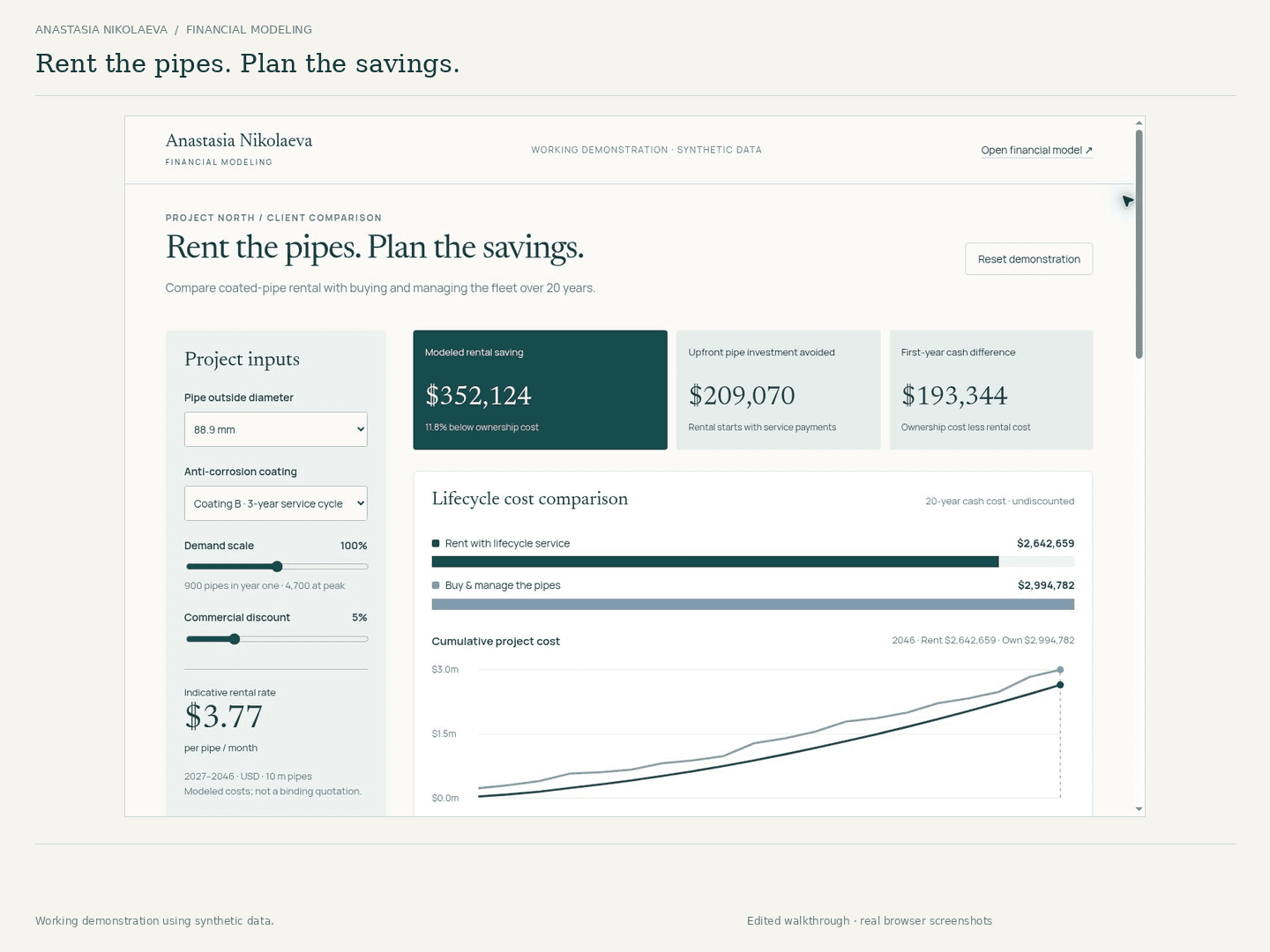
I build a model of how your idea can work financially: revenue, costs, cash needs and different scenarios. It can help you plan the launch, assess an investment or explain the numbers to investors.

Explore models for new ventures

Typical project fee · USD

$500–3,000

Around 2 weeks for a straightforward model

Discuss a new project

Financial models and analytics for existing businesses

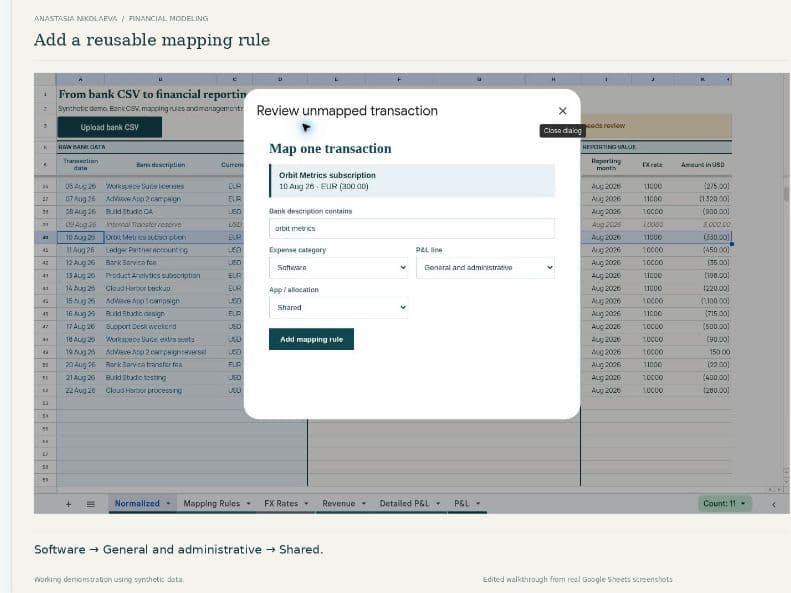
I bring financial data together and build tools for reporting, analysis and planning. Depending on what you need, this can include management or investor reports, profitability analysis, forecasts and decision tools.

Explore models for operating businesses

Typical project fee · USD

$1,000–5,000

Schedule agreed after reviewing your data and scope

Discuss your business

Financial and business consulting

We work through a specific question together: review a model, test assumptions or structure a report. I also help product teams define the metrics and financial calculations behind their software’s dashboards and analytical features.

Explore consulting sessions

Per hour · USD

$90

60-minute working sessions

Ask about consulting
About the price ranges

These ranges reflect typical project fees, not maximum prices. A complete model for an early-stage startup with straightforward economics can start at $500. More complex business logic, additional research, data preparation or integrations can take a project above the ranges shown. After reviewing your materials, I agree a fixed fee with you before work begins. Larger projects can be divided into separately agreed stages.

The free 30-minute introductory call is for discussing your needs and the scope of the work. Paid consulting sessions focus on the question itself. If preparation, a detailed review or follow-up work is needed, we agree the additional time and cost in advance.

About timing

A straightforward startup or new-project model can take around two weeks. Reporting systems and more complex models need a schedule based on the scope and the condition of your data. We agree the delivery schedule before starting, once I have reviewed the available materials. Timing also depends on any research needed and how quickly we can review the work together.

What clients say

Konstantin Moroshin

Konstantin Moroshin

Strategy Director

Healthy4U

[…] the financial model has become the central artifact I work with. It helps me substantiate my position within the team and, without unnecessary fluff, present the project to external stakeholders.

Evgeny Chizh

Evgeny Chizh

CEO

FishStat

With Anastasia's help, we were able to quickly prepare a financial model for our B2B platform and successfully negotiate with an investor. We refined our business model and identified the most promising monetization strategies.

Olesya Shevtsova

Olesya Shevtsova

Founder & CEO

5D Consulting

I’d like to thank Anastasia for her systematic approach to work—it's always clear what to expect and what results you’ll get in the end. […] If you still don’t have a financial model, analytics, or reports, you should definitely reach out to her!

Stanislav Korsunov

Stanislav Korsunov

Founder

Harizma

[…] we had an online consultation, went through the key points and made adjustments. Communicating and working with Anastasia is easy and enjoyable. We recommend her!

Anton Rudenko

Anton Rudenko

Founder & CEO

Convergate

Now we have a clear tool for planning and analysis. The hands-on involvement and consulting to fine-tune the model for us were incredibly valuable. I got many times more value than I expected.

Sergey Petushkov

Sergey Petushkov

Founder & CEO

Tradings World

I needed to create a financial model for a mobile application. […] I was able to understand the approach and later adapt the model to my needs during an individual session with her.

Rodion Rostovshchikov

Rodion Rostovshchikov

Founder & CTO

SportyFinder

I want to express my gratitude to Anastasia for her professional work! The financial model has become an indispensable tool for our business. I highly recommend it to all startups!

1–3 of 7

How I use AI in my work

AI is part of my everyday work, and I want to be open about how I use it. For me, its value is the depth and practical possibilities it adds to a project.

Experience shapes how I use it

I built financial models manually for years: writing formulas, connecting assumptions to forecasts and working through the business logic. That experience helps me give AI the right context, ask useful questions and recognize when an answer misses the point.

I started with help writing formulas and scripts. Today, I use it more broadly to build and explore models. I guide the methodology, challenge the assumptions and review the calculations, results and usability.

The time we gain gives us room to go deeper into your project.

More room to explore

Test more scenarios, examine assumptions more closely and work through alternatives together.

Less repetitive work

Add scripts for data imports, calculations and reporting where automation is useful.

More ways to use the model

Build clearer visualizations, dashboards or an interactive web interface when the project calls for it.

Your information, by agreement

I use AI to develop the model’s structure with sample figures, without sharing your company name. By default, I work with your real numbers without AI. If more AI assistance would be useful, we agree in advance what information can be shared.

Every input needs a basis

I don’t use AI-generated estimates as input assumptions. AI can help me find market benchmarks, but I use them only with a link to a reliable source that I check myself. Your actual data, sourced benchmarks and assumptions we agree together remain clearly distinguished.

A few practical questions

Can we start if my data is incomplete or spread across different files?

Yes. We first look at what you have and what is missing. Organizing the data or researching assumptions can be part of the agreed work. For a new venture, we can start with assumptions and make clear which ones still need testing.

Can you work with a model I already have?

Yes. We can use a consultation to work through a specific question, or agree a project to improve the model. I review the existing file first so we can decide what is useful to keep and what needs to change.

Which tools will we use, and can my team update the model?

We agree the format around how your team will use the result. That may be a spreadsheet, a web interface or a combination. In a financial model, the inputs are separate from the calculations, and I explain how to update the file during handover.

What should I prepare for the first conversation?

A short description of your business or idea, the question you want to answer and any timing constraints is enough. It helps to know what information or files you already have, but you do not need to send confidential materials before the introductory call.

Can you help with updates after handover?

Yes. We can agree a consultation or a further stage of work for new scenarios, changes to the business or additional features. We agree the scope and fee before starting that work.

Free 30-minute introductory call

Let’s talk about your project

Send me a few lines about what you are working on and the decision you need to make. I’ll suggest the next step, including a free introductory call if it would be useful.

No confidential files are needed for this first conversation.