Anastasia Nikolaeva

Financial modeling services

Financial models for startups, businesses and investors

Custom Excel, Google Sheets and web-based models for fundraising, financial planning, performance management and investment decisions.

Discuss your project
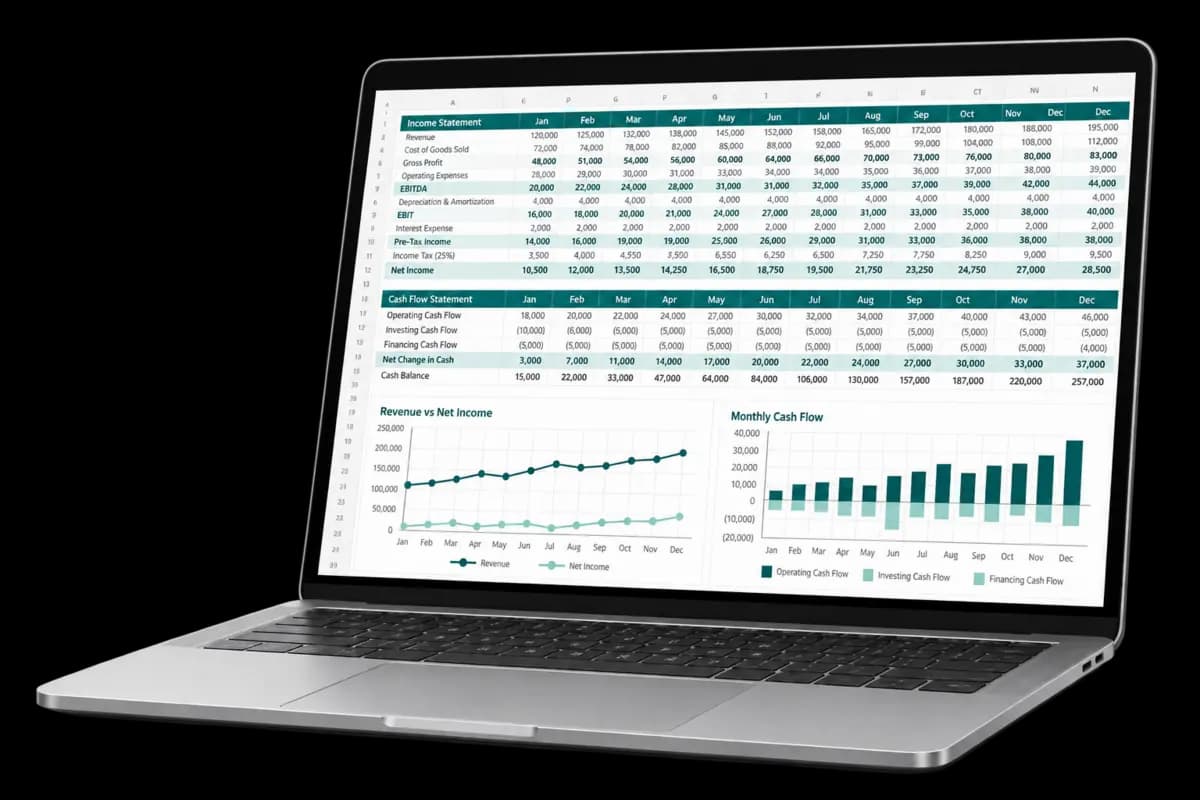
Laptop displaying a financial model with linked statements and forecast charts

Startups and new ventures

Build the financial case before you raise, launch or invest

Models for founders, corporate venture teams and investors who need to challenge an idea, plan capital and explain how the business can grow.

$500–3,000Typical project · USDA straightforward model usually takes around two weeks.
Discuss a new venture model

Fundraising and runway model

Translate the operating plan into a credible capital requirement and a funding story you can defend.

Typical scope
  • Revenue, costs and headcount forecast
  • Burn rate, runway and funding requirement
  • Use of funds and operating milestones

Integrated startup financial model

A connected view of how commercial assumptions flow through the company’s financial statements.

Typical scope
  • P&L, cash flow and balance sheet
  • Revenue, hiring and operating assumptions
  • Base, upside and downside cases

Unit economics and cohort model

Test whether customer acquisition and retention can support profitable, scalable growth.

Typical scope
  • CAC, LTV, churn and retention
  • Channel and customer-cohort economics
  • Gross and contribution margin

Cap table and dilution model

Understand ownership before and after a financing round, including different deal structures.

Typical scope
  • Equity rounds, SAFEs and convertible notes
  • Option pool and founder ownership
  • Dilution and exit-value scenarios

New product, market or project model

Evaluate the commercial case before committing resources to a launch or investment.

Typical scope
  • Price, volume and demand assumptions
  • Launch costs, break-even and payback
  • NPV, IRR and scenario comparison where relevant

Investment screening and portfolio model

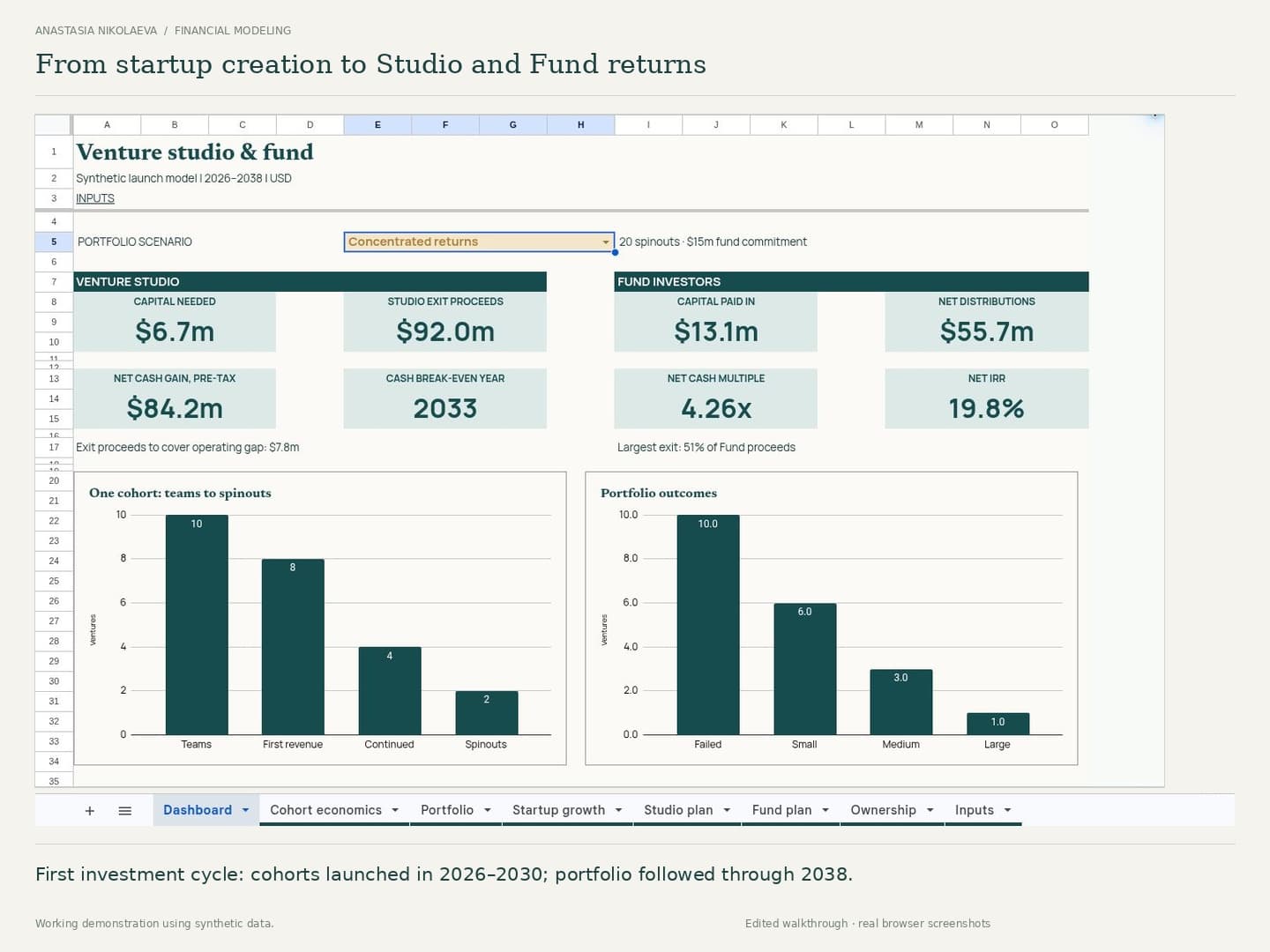
Give a venture studio, fund or private investor a consistent financial view of potential and existing portfolio companies.

Typical scope
  • Standardized startup assumptions and KPIs
  • Funding needs, ownership and follow-on capital
  • Portfolio scenarios, returns and investment comparison

Operating businesses

Turn financial data into a reliable planning system

Models for management teams that need a connected view of performance, cash and the decisions that shape the next forecast.

$1,000–5,000Typical project · USDComplex systems can exceed this range and be delivered in stages.
Discuss a business model

Integrated three-statement planning model

Connect the income statement, balance sheet and cash flow so every planning decision has a complete financial effect.

Typical scope
  • Historical actuals and forecast
  • Linked P&L, balance sheet and cash flow
  • Debt, tax and working-capital schedules

Budgeting and rolling forecast model

Move from a static annual budget to an updateable view of performance and the months ahead.

Typical scope
  • Department, product or regional budgets
  • Monthly or quarterly reforecasting
  • Plan-versus-actual variance analysis

Cash flow and liquidity model

See when cash enters and leaves the business, how much headroom remains and where pressure may appear.

Typical scope
  • Receivables, payables and working capital
  • Short- and medium-term cash forecast
  • Debt service, covenants and liquidity scenarios

Management P&L and profitability model

Understand the true economics of products, markets, channels or business units.

Typical scope
  • Revenue and margin bridge
  • Cost allocation and contribution profit
  • Segment and portfolio performance

Operational driver and KPI model

Link operating activity to financial results and expose the drivers management can influence.

Typical scope
  • Driver trees and KPI definitions
  • Capacity, utilization, pricing and volume
  • Cohorts, funnels or asset lifecycle logic

Investment and expansion model

Compare capital projects, product launches, locations or market-entry options on a consistent basis.

Typical scope
  • Capital expenditure and cash recovery
  • Payback, NPV and IRR
  • Financing and downside scenarios

Consulting and model review

Use a working session to move a decision forward

Online sessions for teams that want an expert second opinion, need to prepare for an important conversation or want to structure a commercial or analytical problem.

$90 / hourOnline consulting · USDPreparation and follow-up work are agreed in advance.
Ask about consulting

Model review and expert sense-check

Bring an existing model—including the one an AI tool produced with impressive confidence. We will check whether its logic is equally convincing.

During the session
  • Formula and structure review
  • Assumption and scenario checks
  • Priorities for correction

Pitch rehearsal for the numbers

Practice presenting the financial and commercial story before an investor, board or important internal meeting—and prepare for the questions behind the spreadsheet.

During the session
  • Revenue logic and unit economics
  • Funding need and key assumptions
  • Challenging questions and clear answers

Commercial and growth strategy

Work through what needs to change to reach a target such as break-even, EBITDA, revenue or customer growth.

During the session
  • Product and pricing choices
  • Acquisition channels and unit economics
  • Cost structure, timing and trade-offs

Analytics and dashboard direction

Structure the analytical layer of a B2B or software product: what different user roles need to understand and how the data should support their decisions.

During the session
  • KPIs and views by user role
  • Dashboard structure and data visualization
  • Calculation logic for the product team

What you receive

A model your team can understand and keep using

Excel, Google Sheets or a web interface—the format follows how the result will be used.

The working model

Editable inputs, connected calculations and decision-ready outputs in an agreed format.

Documented assumptions

Clear notes on inputs, methodology, dependencies and the sources behind researched assumptions.

Walkthrough and handover

An online review of the structure, scenarios, outputs and how to update the model.

Scope, fees and timing

Clear scope and an agreed project fee

The service ranges are a starting point. Your fixed fee reflects the logic, data and outputs we agree to include.

Complex assignments can exceed the typical upper ranges. Larger projects can be divided into separately agreed stages.

Research, data preparation and complex model logic affect the schedule.

Talk through your scope

What influences the fee

Business logic and level of detail

The number of revenue streams, products, regions and acquisition channels matters, along with how differently they behave. A second revenue stream using the same logic may be simple; one with a different sales cycle, cost structure and payment schedule can require a separate model within the model.

Planning horizon and operating relationships

Monthly or quarterly forecasts, customer cohorts, seasonality, capacity, inventory, working capital and asset lifecycles all affect the work involved. The useful level of detail depends on the decisions you need to make.

Funding, ownership and investment calculations

A financial forecast can be extended with a cap table, funding rounds, dilution, debt schedules, ROI, NPV, IRR or portfolio economics. The price reflects the calculations and relationships we agree to include.

Scenarios and sensitivities

Changing a few assumptions is different from comparing alternative business models, market launches or financing structures. We agree which alternatives need to be modeled and how you will switch between them.

Data preparation and research

The scope depends on whether you provide organized actuals and supported assumptions, or need help consolidating data and researching benchmarks. Research is agreed separately within the project, and the sources behind its assumptions are documented.

Automation, interfaces and handover

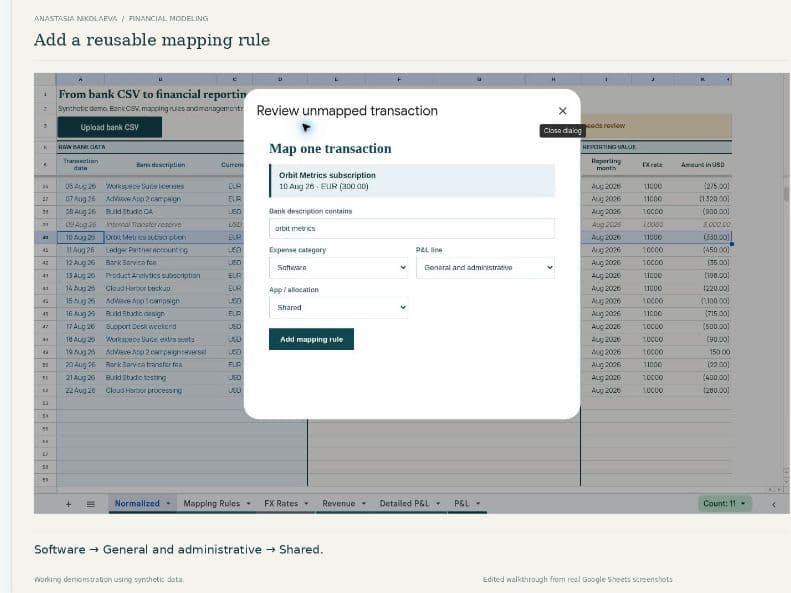
Imports, classification rules, scripts, dashboards and web interfaces add implementation work. Team training, additional documentation and future update requirements are also considered when we define the scope.
Discuss the decision
Agree scope and fee
Build and review
Explain and hand over

Building a startup model yourself? Explore Stavia Models (opens in a new tab).

A few practical questions

Can we start if my data is incomplete or spread across different files?

Yes. We first look at what you have and what is missing. Organizing the data or researching assumptions can be part of the agreed work. For a new venture, we can start with assumptions and make clear which ones still need testing.

Can you work with a model I already have?

Yes. We can use a consultation to work through a specific question, or agree a project to improve the model. I review the existing file first so we can decide what is useful to keep and what needs to change.

Which tools will we use, and can my team update the model?

We agree the format around how your team will use the result. That may be a spreadsheet, a web interface or a combination. In a financial model, the inputs are separate from the calculations, and I explain how to update the file during handover.

What should I prepare for the first conversation?

A short description of your business or idea, the question you want to answer and any timing constraints is enough. It helps to know what information or files you already have, but you do not need to send confidential materials before the introductory call.

Can you help with updates after handover?

Yes. We can agree a consultation or a further stage of work for new scenarios, changes to the business or additional features. We agree the scope and fee before starting that work.

Free 30-minute introductory call

Let’s talk about your project

Send me a few lines about what you are working on and the decision you need to make. I’ll suggest the next step, including a free introductory call if it would be useful.

No confidential files are needed for this first conversation.